pronounced BEE-shawn free-ZAY)

Beverly Weddington
(727) 799-7351

EMAIL: bweddin1@tampabay.rr.com

Welcome to Cambea's Bichon Frise and Maltese located in Clearwater, FL

It is such a pleasure to raise such wonderful puppies as the Bichon Frise!

We believe that superior parents, good nutrition and a clean environment are essential for healthy, happy puppies. This is what we provide to every Cambea Puppy resulting in a lifetime of delightful companionship for you and your family. Each pup is raised with love and care. Health Guarantee Contracts are provided on all dogs with a Veterinarian Issued Health Certificate which will provide your Veterinarian with puppy's current health care.

What is the origin of the Bichon Frise?

I have been asked this question many times and have heard many different answers that I believe to be incorrect. Many breeds can be traced back to the first century A.D. when the Romans had classified dogs into six general "groups": guard dogs, shepherd's dogs, hunting dogs (those hunting by sight and those hunting by sound) and fighting dogs. Still other breeds were developed by combining individuals from two or more of these different categories to create yet another breed.

Barbet Water Spaniel The Bichon family was the result of combining the blood of a medium sized water spaniel type dog and an existing family of light colored small "lap dog" that are said to have had their origin in the far East. The water spaniels were known as the Barbet. From this combination a small, often white, breed of dog evolved that was known as the "small Barbet" or Barbichon - later shortened simply to Bichon.

The little Bichons that had eventually evolved crossed the seas along the trade routes of the world and were often left behind in trade for other goods. The dogs became established and flourished in their new homes, developing into distinct varieties.

These became known as the Bichon Maltaise, the Bichon Bolognaise, the Bichon Havanese, and the Bichon Teneriffe. The Bichon Teneriffe is chiefly credited as the forerunner of today's Bichon Frise.

It is worth noting that the original French standard of the Bichon Frise breed included a clause that made "black spots in the coat" a disqualification. Though all but unheard of in the breed today, one can only surmise it represented a problem at one stage of the breed and could easily have been a result of the Havanese influence.

France Renames the Dog From Teneriffe

The Enclyclopedia of Dogs produced under direction of The Federation Cynologique Internationale (FCI) gives the Bichon Frise's country of origin as France. Part of the fashion trend in the French Courts was Italy's little white Bichon Teneriffe. Francis I (1515-1547 A.D.) was fond of the breed during his reign.

Little appears in French literature about the Teneriffe dog after Francis I reign until the rise of Napoleon III came into power in the early years of the nineteenth century. The Bichon Teneriffe is frequently mentioned in French literature during that century and is frequently portrayed with members of the royal courts in the works of leading artists of the period.

Bichon performing By the end of the nineteenth century the breed was to be replaced in the favor of the court but being a hardy breed that it was the Bichon Teneriffe survived and would more often than not be found in the streets of Paris and other cities accompanying tradesmen and street musicians. The nimble Bichons were highly trainable and loved to perform for the crowds.


Were it not for the indestructible constitution of the Bichon, the breed could well have been lost to us during the First and Second World Wars. Reduced to minimal numbers by the end of World War I, the breed escaped extinction only through the efforts of a few valian fanciers who gathered what remained of the breed from the streets of France and Belgium. Working cooperatively those who found pleasure in the happy little dogs were able to obtain breed recognition under the auspices of the Societe Centrale Canine in March of 1933. The breed was officially given the name "the Bichon A Poil Frise" which translates to "The Bichon of the curly hair".

Daegan Male Bichon Frise In 1952 the Bichon comes to America with Helene and Francois Picault of Deippe, France. In September 1971 the A.K.C. accepted the Bichon Frise into Miscellaneous Class competition. Then late 1972 The Bichon was granted full recognition by the A.K.C. and would be eligible for point competition on April 8, 1973.

Olivia Renowned for their cheerful disposition, Bichons gain friends and devotees wherever they go. Bichons aren't terribly loyal because their best friend is the last person who said "Hi." Bichons can enjoy romping around a large estate or live comfortably in a modest apartment with people who can't take them outside. Bichons adapt to any environment, as long as they can be with people. Although owners tend to pamper their Bichons, the dogs are tougher than they look. They are little, cute and fluffy, so people are inclined to treat them like delicate flowers, which is absolutely unnecessary, The breed was hardy enough to withstand ocean voyages. Bichons like to move, even if only within the confines of a small apartment. They have very sporadic energy. A typical Bichon thing would be to go out into the yard, run two or three laps like a Greyhound, then collapse and spend the rest of the afternoon watching butterflies.

That energy can also translate into a tendency to bolt, so Bichons should be in a fenced yard or on a leash when outdoors. They feel like the whole world loves them so much, and they don't think anything will hurt them.

For those ready to love and be loved around the clock, a Bichon is the perfect match.

The Bichon In Art

As a royal pet, the Bichons were lavished with attention, constantly groomed and ribboned and even made clothes. It is said the French verb bichonner (meaning to pamper or make beautiful) is a tribute to the dog's favor in royal circles. This popularity also led it to be included in many paintings, most notably some by the Spanish artist Francisco Goya.


Francisco de Goya. Portrait of the Dutchess of Alba. 1795. Oil on canvas, 194 x 130 cm. Duke of Alba, Madrid, Spain


Francisco de Goya. The Family of the Duke of Osuna. 1788. Oil on canvas, 225 x 174. Museo del Prado, Madrid, Spain.


Francisco de Goya. Maria Teresa de Borbon y Vallabriga. 1783. Oil on canvas, 132.3 x 116.7 cm. The National Gallery of Art, Washington, DC, USA.


Francisco de Goya. A Woman Reading a Letter. c. 1812-14. Oil on canvas, 181 x 122 cm. Musee des Beaux-Arts, Lille, France.


BICHON FRISE BREED STANDARD

Non-Sporting Group

General Appearance

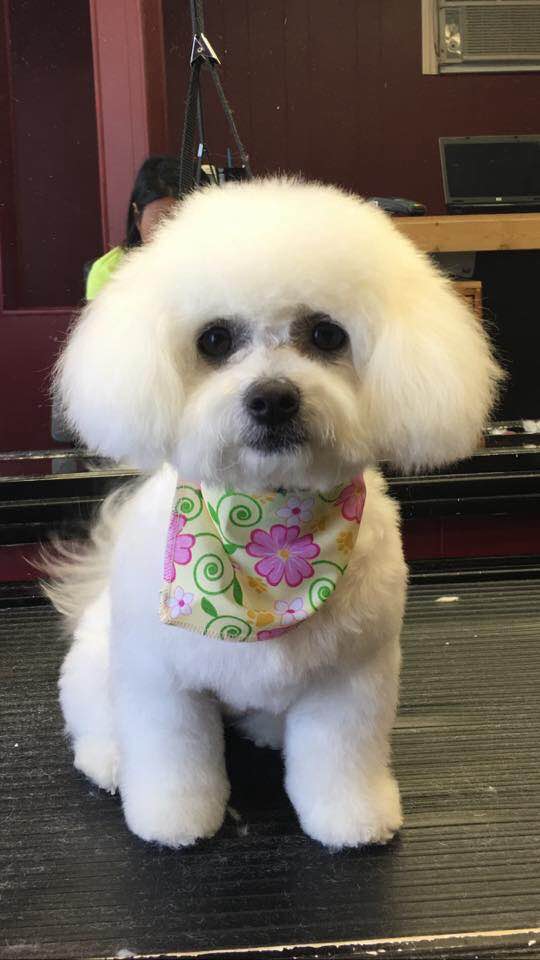
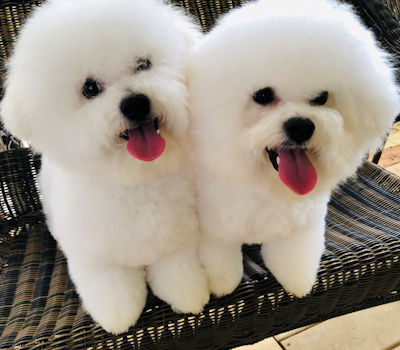
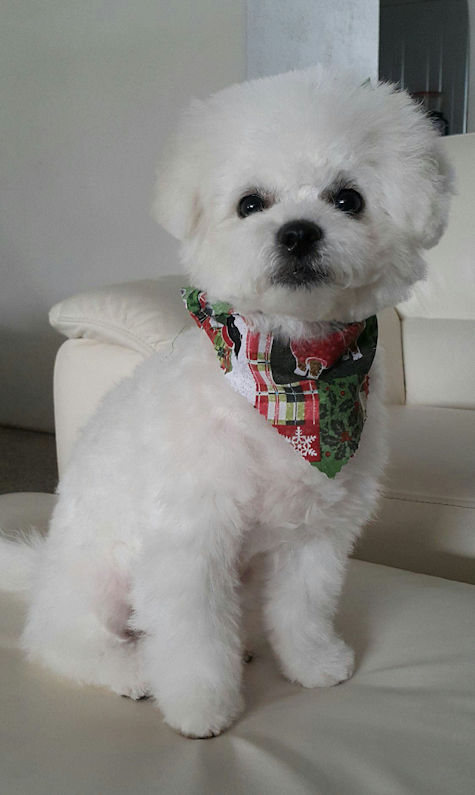
The Bichon Frise is a small, sturdy, white powder puff of a dog whose merry temperament is evidenced by his plumed tail carried jauntily over the back and his dark-eyed inquisitive expression.

This is a breed that has no gross or incapacitating exaggerations and therefore there is no inherent reason for lack of balance or unsound movement.

Any deviation from the ideal described in the standard should be penalized to the extent of the deviation. Structural faults common to all breeds are as undesirable in the Bichon Frise as in any other breed, even though such faults may not be specifically mentioned in the standard.

Size, Proportion, Substance

Size Dogs and bitches 9 1/2 to 11 1/2 inches are to be given primary preference. Only where the comparative superiority of a specimen outside this range clearly justifies it should greater latitude be taken. In no case, however, should this latitude ever extend over 12 inches or under 9 inches. The minimum limits do not apply to puppies. Proportion--The body from the forward-most point of the chest to the point of rump is 1/4 longer than the height at the withers. The body from the withers to lowest point of chest represents 1/2 the distance from withers to ground. Substance--Compact and of medium bone throughout; neither coarse nor fine.

Head

Expression--Soft, dark-eyed, inquisitive, alert. Eyes are round, black or dark brown and are set in the skull to look directly forward. An overly large or bulging eye is a fault as is an almond shaped, obliquely set eye. Halos, the black or very dark brown skin surrounding the eyes, are necessary as they accentuate the eye and enhance expression. The eye rims themselves must be black. Broken pigment, or total absence of pigment on the eye rims produce a blank and staring expression, which is a definite fault. Eyes of any color other than black or dark brown are a very serious fault and must be severely penalized. Ears are drop and are covered with long flowing hair. When extended toward the nose, the leathers reach approximately halfway the length of the muzzle. They are set on slightly higher than eye level and rather forward on the skull, so that when the dog is alert they serve to frame the face. The skull is slightly rounded, allowing for a round and forward looking eye. The stop is slightly accentuated. Muzzle--A properly balanced head is three parts muzzle to five parts skull, measured from the nose to the stop and from the stop to the occiput. A line drawn between the outside corners of the eyes and to the nose will create a near equilateral triangle. There is a slight degree of chiseling under the eyes, but not so much as to result in a weak or snipey foreface. The lower jaw is strong. The nose is prominent and always black. Lips are black, fine, never drooping. Bite is scissors. A bite which is undershot or overshot should be severely penalized. A crooked or out of line tooth is permissible, however, missing teeth are to be severely faulted.

Neck, Topline and Body

The arched neck is long and carried proudly behind an erect head. It blends smoothly into the shoulders. The length of neck from occiput to withers is approximately 1/3 the distance from forechest to buttocks. The topline is level except for a slight, muscular arch over the loin. Body--The chest is well developed and wide enough to allow free and unrestricted movement of the front legs. The lowest point of the chest extends at least to the elbow. The rib cage is moderately sprung and extends back to a short and muscular loin. The forechest is well pronounced and protrudes slightly forward of the point of shoulder. The underline has a moderate tuck-up. Tail is well plumed, set on level with the topline and curved gracefully over the back so that the hair of the tail rests on the back. When the tail is extended toward the head it reaches at least halfway to the withers. A low tail set, a tail carried perpendicularly to the back, or a tail which droops behind is to be severely penalized. A corkscrew tail is a very serious fault.

Forequarters

Shoulders--The shoulder blade, upper arm and forearm are approximately equal in length. The shoulders are laid back to somewhat near a forty-five degree angle. The upper arm extends well back so the elbow is placed directly below the withers when viewed from the side. Legs are of medium bone; straight, with no bow or curve in the forearm or wrist. The elbows are held close to the body. The pasterns slope slightly from the vertical. The dewclaws may be removed. The feet are tight and round, resembling those of a cat and point directly forward, turning neither in nor out. Pads are black. Nails are kept short.

Hindquarters

The hindquarters are of medium bone, well angulated with muscular thighs and spaced moderately wide. The upper and lower thigh are nearly equal in length meeting at a well bent stifle joint. The leg from hock joint to foot pad is perpendicular to the ground. Dewclaws may be removed. Paws are tight and round with black pads.

Coat

The texture of the coat is of utmost importance. The undercoat is soft and dense, the outercoat of a coarser and curlier texture. The combination of the two gives a soft but substantial feel to the touch which is similar to plush or velvet and when patted springs back. When bathed and brushed, it stands off the body, creating an overall powder puff appearance. A wiry coat is not desirable. A limp, silky coat, a coat that lies down, or a lack of undercoat are very serious faults. Trimming--The coat is trimmed to reveal the natural outline of the body. It is rounded off from any direction and never cut so short as to create an overly trimmed or squared off appearance. The furnishings of the head, beard, moustache, ears and tail are left longer. The longer head hair is trimmed to create an overall rounded impression. The topline is trimmed to appear level. The coat is long enough to maintain the powder puff look which is characteristic of the breed.

Color

Color is white, may have shadings of buff, cream or apricot around the ears or on the body. Any color in excess of 10% of the entire coat of a mature specimen is a fault and should be penalized, but color of the accepted shadings should not be faulted in puppies.

Gait

Movement at a trot is free, precise and effortless. In profile the forelegs and hind legs extend equally with an easy reach and drive that maintain a steady topline. When moving, the head and neck remain somewhat erect and as speed increases there is a very slight convergence of legs toward the center line. Moving away, the hindquarters travel with moderate width between them and the foot pads can be seen. Coming and going, his movement is precise and true.

Temperament

Gentle mannered, sensitive, playful and affectionate. A cheerful attitude is the hallmark of the breed and one should settle for nothing less.

Approved October 11, 1988

Effective November 30, 1988

SHOWTIME

This is the AKC

The American Kennel Club was established in 1884 to promote the study, breeding, exhibiting and advancement of purebred dogs. It is the largest not-for-profit purebred dog registry in the nation.

The AKC approves and maintains the official records of over 15,000 sanctioned and licensed events each year.

The AKC has approximately 500 member clubs and over 4,000 affiliated clubs. These clubs are more than show-giving entities. They are public service, educational organizations whose activities benefit their entire community. Some AKC club activities include public education through presentations at schools, fairs, libraries, shelters, hospitals, rescue leagues, scouts and 4-H; training classes; and health clinics.

AKC registration means a dog, its parents, and its ancestors are purebred. It does not indicate health or quality. Dogs registered with the AKC can have their offspring registered and compete in AKC events.

The World of Dog Shows

Showing dogs is a great sport where the thrill of competition is combined with the joy of seeing beautiful dogs. Dog shows are one of many types of AKC dog events in which AKC-registered dogs can compete. These events, which draw over three million entries annually, include dog shows and tests of instinct and trainability, such as obedience trials, Canine Good Citizen tests, field trials, agility trials, lure coursing, rally, hunting tests, herding trials, tracking tests, coonhound and earthdog events.

Dog shows (conformation events) are intended to evaluate breeding stock. The size of these events ranges from large all-breed shows, with over 3,000 dogs entered, to small local specialty club shows, featuring a specific breed. The dog's conformation (overall appearance and structure), an indication of the dog's ability to produce quality puppies, is judged.

Types of Conformation Dog Shows

There are three types of conformation dog shows:

All-breed shows offer competitions for over 150 breeds and varieties of dogs recognized by the AKC. All-breed shows are the type often shown on television

Specialty shows are restricted to dogs of a specific breed or to varieties of one breed. For example, the Bulldog Club of America Specialty is for Bulldogs only, but the Poodle Club of America's specialty show includes the three varieties of the Poodle - Standard, Miniature and Toy.

Group shows are limited to dogs belonging to one of the seven groups. For example, the Potomac Hound Group show features only breeds belonging to the Hound group.

Which Dogs May Participate

To be eligible to compete, a dog must:

* be individually registered with the American Kennel Club
* be 6 months of age or older
* be a breed for which classes are offered at a show
* meet any eligibility requirements in the written standard for its breed

Spayed or neutered dogs are not eligible to compete in conformation classes at a dog show, because the purpose of a dog show is to evaluate breeding stock.

The Role of the Judge

Judges examine the dogs, then give awards according to how closely each dog compares to the judge's mental image of the "perfect" dog described in the breed's official standard.

The standard describes the characteristics that allow the breed to perform the function for which it was bred. These standards include specifications for structure, temperament and movement.

The official written standard for each breed is maintained by the breed's national club and is included in the The Complete Dog Book published by the AKC.

The judges are experts on the breeds they are judging. They examine ("go over") each dog with their hands to see if the teeth, muscles, bones and coat texture conform to the breed's standard. They view each dog in profile for overall balance, and watch each dog gait ("move") to see how all of those features fit together in action.

How a Dog Show Works

Each dog presented to a judge is exhibited ("handled") by its owner, breeder or a hired professional. The role of a handler is similar to that of a jockey who rides a horse around the track and, hopefully, into the winner's circle.

Most dogs in competition at conformation shows are competing for points toward their AKC championships. It takes fifteen points, including two majors (wins of three, four or five points) awarded by at least three different judges, to become an American Kennel Club "Champion of Record."

The number of championship points awarded at a show depends on the number of males ("dogs") and females ("bitches") of the breed actually in competition. The larger the entry, the greater the number of points a male or a female can win. The maximum number of points awarded to a dog at any show is 5 points.

Males and females compete separately within their respective breeds, in seven regular classes. The following classes are offered, and are divided by sex:

Puppy - For dogs between six and twelve months of age, that are not yet champions (optional class).

Twelve-To-Eighteen Months - For dogs twelve to eighteen months of age, that are not yet champions (optional class).

Novice - For dogs six months of age and over, which have not, prior to the date of closing of entries, won three first prizes in the Novice Class, a first prize in Bred-by-Exhibitor, American-bred, or Open Classes, nor one or more points toward their championship (optional class).

Amateur-Owner-Handler – For dogs that are at least six months of age that are not champions. Dogs must be handled in the class by the registered owner of the dog and is limited to exhibitors who have not, at any point in time, been a professional dog handler, AKC approved conformation judge, or employed as an assistant to a professional handler (effective January 1, 2009) (optional class).

Bred By Exhibitor - For dogs that are exhibited by their owner and breeder, that are not yet champions (optional class).

American-Bred - For dogs born in the United States from a mating which took place in the United States, that are not yet champions (mandatory class).

Open - For any dog of the breed, at least 6 months of age (mandatory class).

After these classes are judged, all the dogs that won first place in a class compete again to see who is the best of the winning dogs. Males and females are judged separately. Only the best male (Winners Dog) and the best female (Winners Bitch) receive championship points. The Winners Dog and Winners Bitch then compete with the champions for the Best of Breed award. At the end of the Best of Breed Competition, three awards are usually given:

Best of Breed - the dog judged as the best in its breed category.

Best of Winners - the dog judged as the better of the Winners Dog and Winners Bitch.

Best of Opposite Sex - the best dog that is the opposite sex to the Best of Breed winner.

The Road to Best in Show

Dog shows are a process of elimination, with one dog being named Best in Show at the end of the show.

Only the Best of Breed winners advance to compete in the Group competitions. Each AKC-recognized breed falls into one of seven group classifications. The seven groups are Sporting, Hound, Working, Terrier, Toy, Non-Sporting and Herding. Four placements are awarded in each group, but only the first-place winner advances to the Best In Show competition.

The Seven Groups in All-Breed Shows

Sporting - These dogs were bred to hunt game birds both on land and in the water. The breeds in this group include Pointers, Retrievers, Setters and Spaniels.

Hounds - These breeds were bred for hunting other game by sight or scent. These breeds include such dogs as Beagles, Bassets, Dachshunds and Greyhounds.

Working - These dogs were bred to pull carts, guard property and perform search and rescue services. Among the breeds in this group are the Akita, Boxer, Doberman Pinscher and St. Bernard.

Terrier - This group includes breeds such as the Airedale, Cairn Terrier and Scottish Terrier. Terriers were bred to rid property of vermin such as rats.

Toy - These dogs were bred to be household companions. This group includes little dogs such as the Chihuahua, Maltese, Pomeranian and Pug.

Non-Sporting - This diverse group includes the Chow Chow, Bulldog, Dalmatian, Bichon Frise and Poodle. These dogs vary in size and function, and many are considered companion dogs.

Herding - These dogs were bred to help shepherds and ranchers herd their livestock. The Briard, Collie, German Shepherd Dog and Old English Sheepdog are some of the breeds in this group.

Finally, the seven group winners are brought into the ring where they compete for Best In Show, the highest award at a dog show.

Ribbons

Each dog that receives an award is given a ribbon by the judge. The color of the ribbon indicates the type of award the dog has won.

Blue - awarded for first place in any regular class. Also awarded to the winner of each group competition, usually in the form of a "rosette".

Red - awarded for second place in each class. Also awarded for second place in each group competition, usually in the form of a "rosette".

Yellow - awarded for third place in each class. Also awarded for third place in each group competition, usually in the form of a "rosette".

White - awarded for fourth place in each class. Also awarded for fourth place of each group competition, usually in the form of a "rosette".

Purple - awarded to the winners of the Winners Dog and Winners Bitch classes. Since these are the classes in which championship points are earned, these ribbons are highly coveted.

Purple and White - awarded to the Reserve Winners; that is, the runners-up to the winner of the Winners Dog and Winners Bitch classes.

Blue and White - awarded to the dog that wins Best of Winners; that is, the better of the Winners Dog and Winners Bitch winners.

Purple and Gold - awarded to the dog judged "Best of Breed" in each breed competition. This is highly coveted because it allows advancement to the Group competition.

Red and White - awarded to the Best of Opposite Sex. This means the best dog of the breed that is the opposite sex of the Best of Breed winner.

Red, White and Blue - only one of these is awarded, at the end of each show. It is given to the ultimate award winner, the Best In Show.

How Do I Get Started Showing My Dog?

The best place to start is by joining a local kennel club, whether an all-breed kennel club or a breed-specific specialty club. A listing of clubs by state can be found on AKC's Club Search page or through AKC's customer service department by calling (919) 233-9767.

Local clubs will have information on training classes for the show ring, and for obedience and agility classes. Even if the show ring is not your ultimate goal, the relationship that training forms between you and your dog will be very rewarding to you both. Local clubs also have "Matches" where you and your dog can test your skill in the ring.

Handling your dog is an exceptional and enjoyable experience. From the grooming table to the show ring, you and your dog will develop a bond. While training classes offer the best hands-on way to practice for the show ring, attending shows and observing your breed is also a great way to gain understanding of what judges and other competitors do.

If you do not wish to handle your dog yourself, or have a friend or family member do it, you may contact a professional handler who charges a fee for showing your dog.

You're on your way! You are entering a sport that will bring many hours of enjoyment and education to every member of your family. You will make many friends in the sport, and will enjoy your dog and your new hobby for many years to come.

Junior Showmanship

The AKC offers children 9 to 18 years of age the opportunity to compete with others their own age at various AKC events. Juniors competing in conformation events are judged on how they present their dogs.

Tips for the First-Time Exhibitor

* Make sure your dog is registered with the AKC.
* Be sure your dog is current on all inoculations.
* Learn the proper techniques for grooming and for presenting your dog in the ring.
* Join your breed's Parent Club, or a Local Specialty and/or All-Breed club in your area.
* Become familiar with the AKC rules and regulations for dog shows.
* Attend some dog shows to observe your breed being judged and how others present your breed. Get a Judging Program at the show to find out ring number and judging time.
* Use the knowledge of your breeder.
* Don't be afraid to ask questions.
* Attend handling classes with your dog.

Tips for the First-Time Spectator

* If the grooming area is open to spectators, visit it and talk with professional groomers to get tips on keeping your dog looking his best.
* However tempting, do not pet a dog without asking for permission first. The dog may have just been groomed in preparation for being judged.
* At each dog show, you will find vendors and information booths. Many club booths offer helpful information to the general public.
* Wear comfortable shoes - you'll be doing a lot of walking. Unless you bring a chair or arrive early, be prepared to stand most of the time, as seating is usually limited.
* If you are considering getting a purebred dog, talk to the breeders and exhibitors - they are experts in their breeds
* If you bring a baby stroller to a dog show, be careful that you do not run over any dog's tail, and that your child does not grab or poke the dogs it can reach. Avoid having them near ring entrances, which are especially crowded. Some shows prohibit baby strollers.

Dog Show Terms

Angulation - Angles created by bones meeting at their joints.

Baiting - Using liver or some treat to get the dog's attention and have him look alert.

Bench Show - A dog show at which the dogs are kept on assigned benches when not being shown in competition, so they can be viewed and discussed by attendees, exhibitors and breeders.

Exhibitor - A person who brings a dog to a dog show and shows it in the appropriate class.

Fancier - A person who is especially interested, and usually active, in some phase of the sport of purebred dogs.

Gait - The way a dog moves, movement is a good indicator of structure and condition.

Groom - To brush, comb, trim or otherwise make a dog's coat neat.

Handler - A person or agent who takes a dog into the show ring or who works the dog at a field trial or other performance event.

Heel - A command to a dog to keep close beside its handler.

Match Show - A usually informal dog show at which no championship points are awarded.

Miscellaneous Class - Transitional class for breeds attempting to advance to full AKC recognition.

Pedigree - The written record of a dog's family tree of three or more generations.

Points - Credits earned toward a championship.

Soundness - Mental and physical well-being.

Stacking - Posing the dog's legs and body to create a pleasing picture.